









ABOUT FREECELL SOLITAIRE
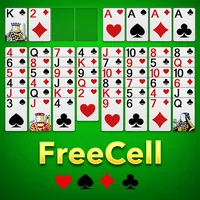
FreeCell Solitaire combines the familiar objective of traditional solitaire with a puzzle-like structure that places greater emphasis on strategy. Every card is dealt face-up, eliminating hidden information and turning each game into a challenge of organization and foresight. Players must carefully balance short-term progress with long-term positioning while working toward building complete foundation stacks. Because each decision affects future possibilities, FreeCell Solitaire often feels more like solving a complex logic puzzle than playing a typical card game. The result is a thoughtful experience that rewards patience and careful planning.
HOW TO PLAY FREECELL SOLITAIRE
Intro
Organize cards into descending sequences while using free cells and empty columns to create room for movement. The ultimate goal is to transfer every card to the foundation piles.
Getting Started
- Focus on uncovering useful card sequences.
- Move aces and low cards to foundations early when appropriate.
- Avoid unnecessary card transfers.
- Use temporary spaces efficiently.
- Keep future moves in mind before rearranging stacks.
Pro Tips
- Strong positions often come from preserving flexibility.
- Think of free cells as resources that should be managed carefully.
- Prioritize moves that reveal additional cards.
- Large sequences become easier to move with empty columns available.
- Patience usually leads to stronger solutions.
CONTROLS
Mouse Drag: Move cards between locations Double Click: Auto-move cards to foundations when possible Touch Input: Control gameplay on mobile devices
Hint: Suggest potential moves Undo: Step back through previous actions Restart: Reset the current deal
FREQUENTLY ASKED QUESTIONS
How is FreeCell Solitaire different from Klondike Solitaire?
FreeCell Solitaire reveals all cards from the beginning, placing greater emphasis on planning rather than uncovering hidden information.
What should I prioritize early in a game?
Creating mobility and opening useful card sequences are often strong early objectives.
Why do experienced players value empty columns?
Empty columns provide flexibility and make it easier to reorganize large groups of cards.
Can difficult deals still be completed?
Many challenging deals can be solved through careful analysis and efficient use of available space.
Does FreeCell Solitaire have a scoring system?
Many versions include scores, completion times, or move counts to track performance.
What skill improves most through regular play?
Strategic planning and recognizing future move possibilities tend to improve significantly.
Is FreeCell Solitaire suitable for relaxing gameplay?
Yes. Players can take their time without the pressure of fast-paced action.
Why has FreeCell Solitaire remained popular for decades?
Its combination of accessibility, depth, and replay value continues to appeal to a wide audience.
RELATED GAMES
- daily-solitaire
- freecell
- mahjongg-solitaire
- solitaire
- solitaire-classic
CATEGORIES
card-games